More Than Just a Game: The 5 Most Surprising Shifts of the 2026 World Cup
The 2026 World Cup has officially shattered the narrow definition of a soccer tournament. We entered this summer wondering if a 48-team, three-nation behemoth could even function, and we emerged with a global cultural shift that has redefined our relationship with the sport. From the sleep-deprived professionals in the Middle East braving "all-night viewing" habits to the logic-defying expansion across the North American continent, the "beautiful game" has successfully reconciled with the complex realities of modern logistics and global work schedules. It is no longer just a tournament; it is a new world standard.
1. The Record-Shattering Scale of North American Fandom
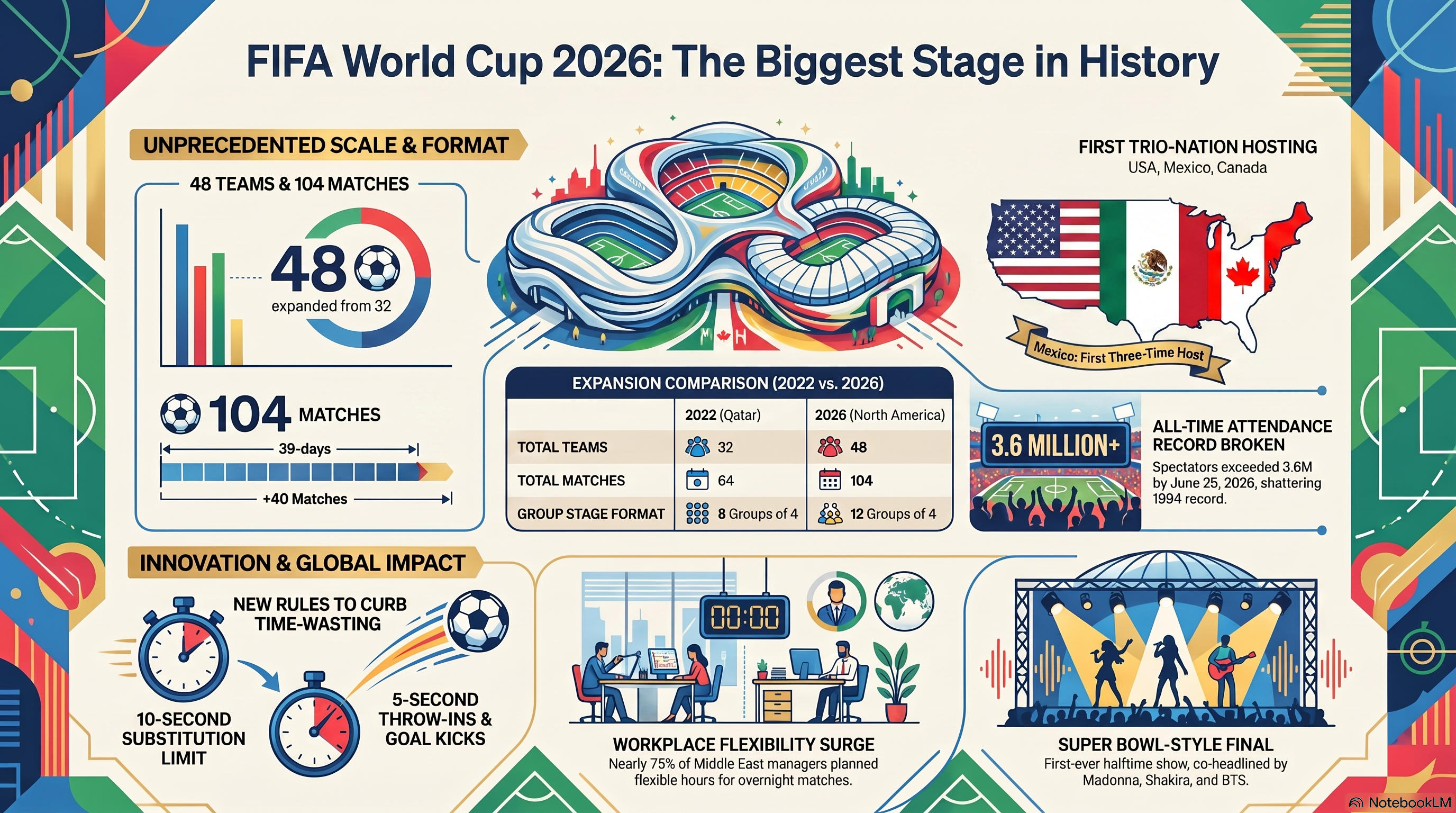
For years, the purists and the skeptics warned us that expanding the field to 48 teams would "dilute the quality" of the World Cup. They were wrong. The numbers tell a story of a continent obsessed and a format that has breathed new life into the competition. By June 25, 2026, the tournament reached a staggering total attendance of 3,605,357 spectators. This wasn’t just a milestone; it was the final burial of the 32-year-old record set during the 1994 World Cup.
With a near-perfect 99.7% average occupancy rate, the cultural footprint is undeniable. Far from being "too much soccer," the 104-match schedule provided the oxygen necessary for the global game to expand, welcoming debutants like Jordan, Uzbekistan, Cape Verde, and Curaçao. Most importantly, the quality hasn't just held steady—it has soared. We are currently witnessing an electrifying scoring average of 2.93 goals per match, objective proof that volume hasn't come at the cost of brilliance.
"FIFA World Cup 2026: Five nations bow out as race for round of 32 heats up" — The Times of India
2. The "Quantified Game": An Anti-Time-Wasting Revolution
We have entered the era of the "Quantified Game," where every second of delay is strictly penalized by the clock and the camera. The International Football Association Board (IFAB) has effectively declared war on the "dark arts" of the sport, and the results are transformative.
The new rulebook for 2026 is designed for transparency and relentless pace:
- The 10-Second Substitution: If a player doesn't exit the pitch within 10 seconds, the incoming substitute is forced to wait for one minute in a "sin bin" of sorts, leaving their team temporarily shorthanded.
- The 5-Second Restart: Referees now use a visual countdown for restarts. If the ball isn't in play within five seconds on a throw-in or goal kick, the restart is awarded to the opponent. Critically, if this infraction occurs during a goal kick, the opponent is awarded a corner kick—a high-stakes penalty that has managers sweating on the sidelines.
- The 1-Minute Medical Rule: Any outfield player receiving medical treatment on the pitch must now leave and wait for a full minute before returning, ending the era of the strategic "cramp."
- Mouth-Covering Red Cards: In a bid to stop toxic behavior hidden from lip-readers, any player covering their mouth while confronting an official or opponent is immediately sent off.
These rules aren't just technicalities; they represent a fundamental shift toward a faster, more disciplined, and more modern version of the game.
3. Soccer Meets the Super Bowl: The Americanized Spectacle
The 2026 Final marks the point where FIFA decided to stop competing with the Super Bowl and simply adopt its blueprint. The final match will feature a halftime show of such massive scale—curated by Chris Martin and co-headlining Madonna, Shakira, and BTS—that it signals a permanent change in FIFA’s philosophy.
While the show supports the Global Citizen Education Fund, there is a deeper cultural commentary at play. To the purist, this "Americanization" might feel like a garish distraction from the sport's sanctity. But to the global marketer, it is the logical evolution of a broadcast event designed to capture the attention of a demographic that doesn't know an offside trap from a goal kick. The "Final Show" is no longer just a match; it is the ultimate global pop-culture apex.
4. The 24/7 Global Workplace: Shifting Managerial Mindsets
Perhaps the most surprising shift hasn't happened on the pitch, but in the office. The tournament’s North American time zones have forced a global reckoning with productivity. In the Middle East, where fans are surviving on all-night viewing, the expected $17 billion hit to global productivity should have caused a corporate crackdown.
Instead, a study by GulfTalent reveals a fascinating shift in power dynamics. Nearly 75% of managers are offering flexible starts or remote work options. Why? Because the managers themselves are part of the phenomenon; the study found they are twice as likely as their subordinates to work from home after a late match. Rather than fighting the tide, employers are choosing camaraderie—turning potential economic loss into a team-building victory through office prediction contests and themed celebrations. If you are struggling to coordinate with colleagues across different regions during these matches, use our International Meeting Planner to find the best overlapping hours.
"Some employers expressed concern about the impact of the games on output, while others were more relaxed or even saw an opportunity." — GulfTalent
5. Rocket Science on the Pitch: The NASA-Tested Ball
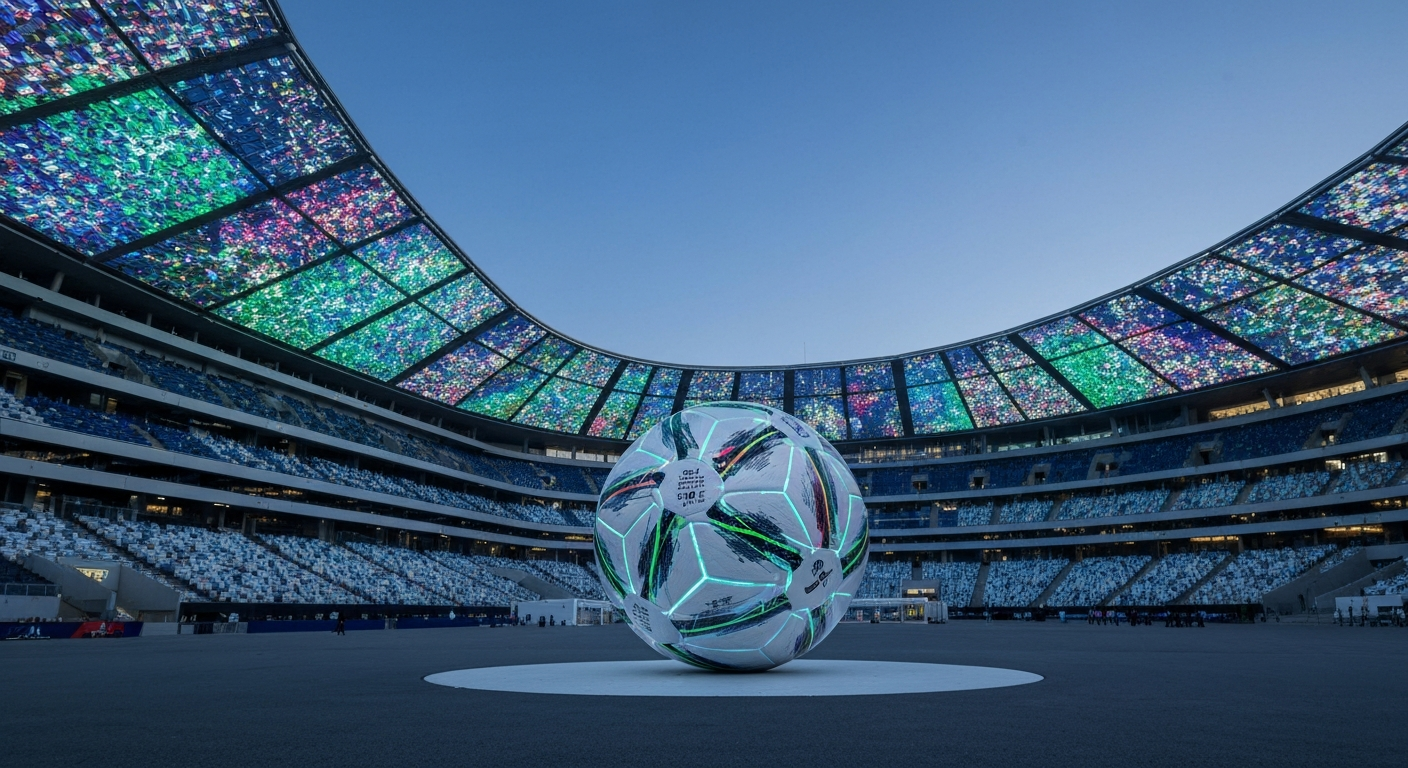
We have reached a point where the trajectory of a match ball requires the same degree of calculation as a lunar insertion burn. The Adidas Trionda (designed in the iconic Red, Green, and Blue of the hosts) is the most scientifically scrutinized object in sports history.
NASA actually conducted experiments on the International Space Station to study the ball’s stability in microgravity. Why go to such extremes? Because in a 104-match marathon, the margin for error must be zero. To maintain sporting integrity across different climates and altitudes, the mass distribution and sensor technology must be flawless. It is a testament to the extremes of modern sports science: a game played with a simple ball now requires literal rocket science to ensure its perfection.
Conclusion: The New World Standard
The 2026 World Cup has permanently altered the template for global sport. By successfully merging massive expansion with technical depth and a new entertainment-first philosophy, this edition has redefined what a "standard" tournament looks like. It is no longer just about the 90 minutes; it is about the tech, the scale, and the cultural flex. Ensure you never miss a match or a meeting by utilizing our International Meeting Planner to stay on top of your schedule.
As we look toward the 100th anniversary in 2030, a provocative question looms: can the World Cup ever return to a smaller, more traditional scale, or have we become so addicted to this expanded, high-gloss format that there is no going back?
Ready to manage time zones better?
Use the International Meeting PlannerRelated Articles
How to Schedule Meetings Across 4 Time Zones: Your 2026 Guide
63% of global remote workers say time zone misalignment is their top collaboration barrier. Scheduling meetings across different time zones in 2026 demands precision, awareness of daylight saving time (DST), and the right tools. We help you avoid late nights and early mornings so your distributed team stays in sync without the spreadsheet maths.
The Ultimate Guide to Managing Time Zones for Remote Teams
Discover practical strategies and tools to keep your globally distributed team in sync without the scheduling headaches.