
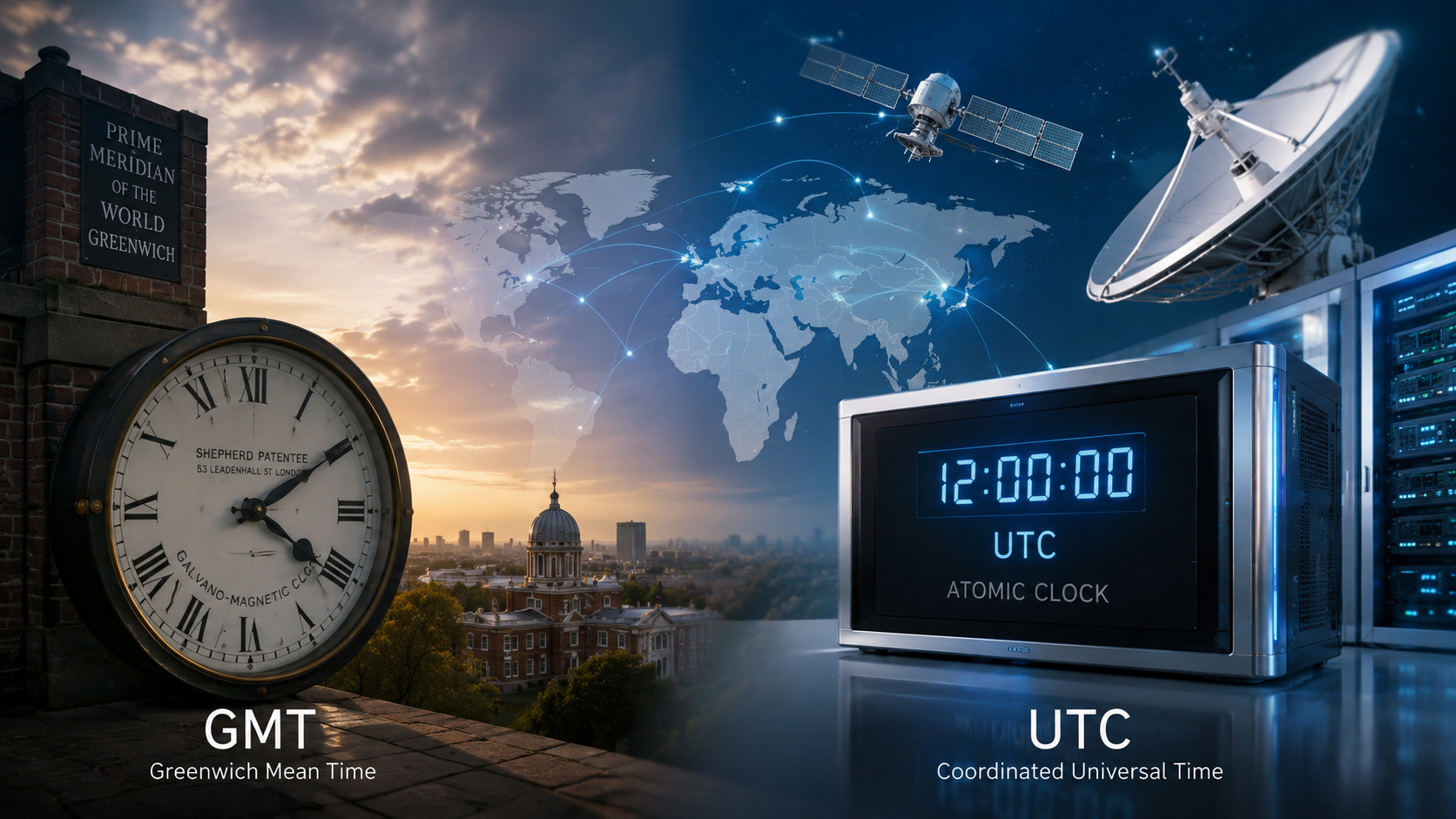
GMT vs UTC: What's the Difference and Why Does It Matter?
Most people use GMT and UTC interchangeably — and most of the time, they'll get away with it. But if you're a remote worker scheduling a call across continents, a developer debugging a timestamp mismatch, or a traveller trying to figure out when your flight actually departs, the distinction between these two time standards can matter more than you'd expect. Here's everything you need to know.
A Brief History of GMT
Greenwich Mean Time has been around since 1675, when the Royal Observatory was established in Greenwich, England. Its original purpose was purely nautical: sailors needed a reliable reference point to calculate their longitude at sea. The meridian line running through Greenwich became the agreed prime meridian — longitude zero — and the time at that meridian became the global reference.
By the late 19th century, the world needed a coordinated time system badly. Trains were crashing because towns ran on slightly different local times. In 1884, the International Meridian Conference in Washington, D.C. formalised Greenwich as the prime meridian for the world, and GMT became the international standard. It held that title for nearly a century.
How UTC Came to Replace It
GMT worked well for an era of ships and railways. It did not work so well for atomic clocks, satellite navigation, and global computer networks.
The problem is that GMT is based on the rotation of the Earth — specifically, the position of the sun as observed from Greenwich. The Earth's rotation, it turns out, is not perfectly consistent. It wobbles. It slows down slightly over time. Basing a global time standard on something so variable was fine when the margin of error was seconds or minutes, but modern systems increasingly needed precision down to fractions of a second.
In 1960, the International Telecommunication Union introduced Coordinated Universal Time — UTC — as a scientifically rigorous replacement. UTC is based on International Atomic Time (TAI), derived from around 400 atomic clocks worldwide that are accurate to within nanoseconds. To keep UTC in sync with the Earth's actual rotation, occasional "leap seconds" are added (or theoretically subtracted). This way, UTC stays both scientifically precise and practically aligned with the solar day.
UTC officially became the global civil time standard in 1972.
The Key Technical Differences
So what actually separates GMT from UTC?
GMT is an astronomical standard. It is measured by the position of the sun relative to the Greenwich meridian. It is a time zone — one you can live in, one that countries like the UK and Ireland observe in winter.
UTC is a time scale. It is not a time zone. No country "lives in UTC." It is a universal reference point maintained by atomic clocks and coordinated internationally. It never adjusts for daylight saving time, and it does not correspond to any particular place on Earth.
The offset between GMT and UTC is, in practice, never more than 0.9 seconds — and for most everyday purposes, this difference is completely irrelevant. But for systems that require precision — and there are many — it is not.
One important nuance: the UK observes GMT in winter and British Summer Time (BST, which is UTC+1) in summer. UTC, by contrast, never changes. It has no summer or winter adjustment. UTC is always UTC.
When the Difference Actually Matters
Aviation
Aviation uses UTC universally — every flight plan, weather report, and air traffic control communication worldwide is logged in UTC. This eliminates any ambiguity caused by time zones, daylight saving transitions, or regional conventions. If a pilot says "wheels up at 14:00Z," the Z stands for Zulu — the NATO phonetic for UTC. There is no room for confusion about which time zone is meant.
Computing and Software
Computer systems almost always store and process times in UTC. When your server logs an event, it records it in UTC. When a database timestamps a transaction, it uses UTC. This is because UTC is unambiguous: it doesn't shift seasonally, and it provides a single consistent reference for systems that span multiple time zones and continents.
Developers who store local times instead of UTC regularly encounter bugs around daylight saving transitions — moments where the same local time occurs twice, or an hour disappears entirely. UTC sidesteps this entirely. If you've ever wondered why your phone might show slightly different times for messages sent across time zones, the answer often comes down to how well UTC was implemented (or wasn't) in the app.
When you use the easyworldclock.com time difference calculator, the calculations run against UTC under the hood — ensuring accuracy regardless of which cities or time zones you're comparing.
Finance
Global financial markets run on precise, legally meaningful timestamps. Stock exchanges, payment processors, and regulatory bodies all require that trades and transactions be recorded in UTC. The London Stock Exchange, NASDAQ, and countless others use UTC as their reference. A timestamp that is off by even a few seconds in high-frequency trading can have significant financial and legal consequences. When regulators audit trades, they want UTC — not local time, not GMT with seasonal adjustments.
Practical Tip: Checking Times Across the World
Whether you're booking a meeting with a client in Singapore, catching a live stream from New York, or keeping track of market open times in Tokyo, working from a single UTC reference eliminates guesswork. The easyworldclock.com world clock shows current times across major cities alongside their UTC offsets — so you always know exactly where each city stands relative to the global standard.
The Bottom Line
GMT and UTC point to essentially the same moment in time — but they represent two very different ideas. GMT is a historical, astronomical convention. UTC is a modern, atomic, universally maintained standard built for a world that needs precision across computing, aviation, finance, and global communication. Knowing the difference won't change your day most of the time, but it will save you real confusion at the moments that count.
Next time you're coordinating across time zones, skip the guesswork. Use the easyworldclock.com world clock to see live times worldwide, and the time difference calculator to plan meetings and travel without the headache. Both run on UTC — because when it comes to time, precision matters.
Frequently Asked Questions
Ready to manage time zones better?
Check the World ClockRelated Articles
The Ultimate Guide to Managing Time Zones for Remote Teams
Discover practical strategies and tools to keep your globally distributed team in sync without the scheduling headaches.
The Strange History of Daylight Saving Time
Why do we change our clocks twice a year? Dive into the fascinating, frustrating history of Daylight Saving Time.